
EMR Lite: From Documentation to Delegation
EMR Lite is designed for practices that want more than faster notes. It’s built to reduce the operational work that follows every visit—without forcing you into a full EHR migration.
This overview walks through how EMR Lite supports the full visit lifecycle, from scheduling to follow-up, while keeping you in control at every step.
Calendar: reduce friction before the visit starts
The calendar in EMR Lite is intentionally simple. It gives you what you need to manage time without adding complexity.
- View schedules by provider and location
- Create one-off or recurring time blocks
- Drag and drop appointments as plans change
- Filter quickly to see only the providers or locations you care about
The goal isn’t a “better calendar.” It’s fewer gaps, fewer interruptions at checkout, and faster answers when a patient asks, “When can I come back?”
The appointment finder helps staff quickly locate future availability by provider, date range, and time of day—without scanning weeks of schedules.
The visit flow: keep documentation moving without stopping care
During the visit, EMR Lite builds on the subQdocs note taker you’re already familiar with.
Medical assistants and providers can see:
- What’s being recorded now
- What’s coming up next
- What’s already completed
The pre-visit view is generated automatically, followed by the clinical note after the encounter. This keeps the visit flowing without requiring staff to stop and document manually.
Prescriptions, labs, and pathology—prepared automatically
Where EMR Lite becomes powerful is what happens after the note.
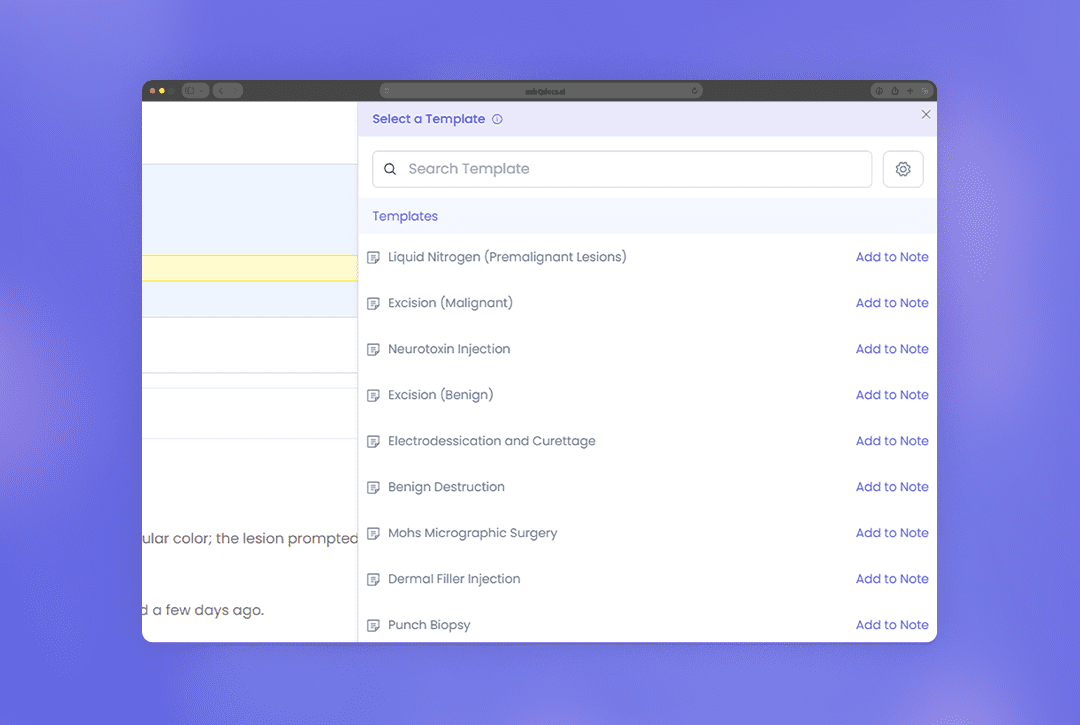
As prescriptions, labs, and pathology are discussed in the room, EMR Lite prepares them automatically using:
- Your past behavior
- Saved favorites
- Common best-practice defaults
You don’t need to repeat every detail out loud. The system fills in sigs and context based on how you typically practice. You review, make adjustments if needed, and approve.
You’re always in control—but you’re no longer starting from a blank screen.
Results management: close the loop without manual tracking
When lab or pathology results return, EMR Lite reads and categorizes them automatically.
For each result, the system proposes:
- A result classification
- A follow-up plan
- Next actions to complete the task
You can approve the plan as-is, adjust it, or choose whether the action should be handled by you or by Q.
Once approved, EMR Lite tracks progress end to end—calls made, messages sent, follow-ups scheduled—so nothing quietly falls through the cracks.
Patient communication: automation with guardrails
Not every patient needs the same level of follow-up.
With EMR Lite, you decide:
- Which results should trigger a phone call
- Which can be handled by text or message
- When escalation is required
For example, benign results may be communicated automatically, while more complex cases remain fully clinician-led.
The system learns from your decisions over time—either explicitly when you adjust steps, or implicitly by observing your patterns.
What EMR Lite is designed to solve
EMR Lite exists to reduce the operational load that surrounds patient care:
- Fewer missed tasks and follow-ups
- Less reliance on manual tracking systems
- Lower MA training burden
- Reduced after-hours documentation
Instead of adding more staff to manage work, EMR Lite focuses on moving work forward automatically—while keeping clinicians firmly in control.
A starting point, not a full replacement
EMR Lite is intentionally scoped. It’s designed to complement your existing workflows and grow with your practice.
This overview covers more than can realistically fit into a short video, but it should give you a clear sense of how EMR Lite shifts subQdocs from documentation into delegation.
If you have questions about whether EMR Lite fits your practice, we’re happy to walk through it with you.
Additional Resources
A dermatologist, a tech visionary, and an AI expert joined forces to redefine value creation and documentation efficiency in dermatology—unlocking smarter workflows and better patient care.



Reserve your spot
Please share a few details so we can plan the evening.